Crypto Tax Adviser: Tax advice on cryptocurrencies, NFTs and digital assets
Our Full-Service Crypto Offering: Specialist tax expertise combined with a technical understanding of the crypto markets
ACCONSIS offers private investors, traders and businesses a full-service crypto tax advisory service. Our team of tax advisers and specialist tax lawyers takes care of the complete processing of your transaction data, the tax assessment and the preparation of your crypto tax return. We are available to assist you both at our Munich office and online. As tax advisers specialising in cryptocurrencies, we are familiar with the current legal landscape (including BMF circulars and DAC8) and the requirements of the tax authorities, drawn from our day-to-day practice.
Table of Contents
An overview of ACCONSIS’s crypto tax advisory services
Our comprehensive crypto tax advisory service covers the entire process chain. This means you benefit from a technically sound and clearly documented tax classification, whilst the effort required on your part is minimal:
- Comprehensive processing of all transaction data (exchanges, wallets, DeFi, NFTs, staking, lending, etc.)
- Tax treatment of the transactions (including FIFO, holding periods, classification as a private disposal, other income or commercial activity)
- Completing a full crypto tax return
- Support with voluntary disclosures relating to cryptocurrency
- Support with tax audits and communication with the tax office
Crypto tax advice for businesses
Blockchain technology raises new tax issues for businesses. These include, amongst others:
- How do I record crypto income correctly?
- What are the tax implications of trading in cryptocurrencies?
- Are the costs of a crypto loan deductible as business expenses?
Your ACCONSIS contact

Kerstin Weidenbach-Koschnike
Diplom-Kauffrau
German CPA, Tax Consultant
Managing Director of ACCONSIS
Service phone
+49 89 54 71 43
or via email
k.weidenbach-koschnike@acconsis.de
Your ACCONSIS contact

Dr. Christopher Arendt
Lawyer, specialised lawyer for tax law
Managing Director of ACCONSIS
Service phone
+49 89 547143
or via email
c.arendt@acconsis.de
Blockchain tax advice with a full-service crypto offering:
taxation of cryptocurrencies, NFTs and other digital assets.
Our blockchain experts will be happy to assist you.
Why you should rely on our expertise when it comes to taxing cryptocurrencies
With our full-service crypto offering, we take a holistic view of your digital assets: we combine technical market insight, tax optimisation and legal protection in a comprehensive solution:
When is it a good idea to hire a crypto tax adviser?
A specialist crypto tax adviser is particularly useful when transactions are no longer easily traceable or when special tax cases arise. This often applies to investors and traders with multiple exchanges and wallets, but also to users of staking, lending, DeFi or NFTs.
Typical cases in which we assist clients include:
- Numerous or complex crypto transactions: purchases, sales and transfers across various exchanges and wallets must be fully consolidated and correctly classified for tax purposes.
- Staking, lending, mining or airdrops: Additional income from cryptocurrencies may be treated differently for tax purposes than traditional capital gains.
- DeFi and token swaps: Liquidity pools, swaps and other DeFi transactions may require a detailed review of each individual transaction.
- NFTs: Depending on their use and scope, different tax issues arise when buying, selling or creating NFTs.
- Missing or incorrect transaction data: Incomplete tax reports, missing acquisition costs or wallet transfers that have not been correctly identified may lead to incorrect results.
- Unreported crypto gains from previous years: In such cases, we will assess whether and in what form tax returns need to be amended or submitted retrospectively.
- Enquiries or audits by the tax office: We assist with preparing the necessary documentation and handle all tax-related correspondence with the tax authorities.
The more complex the transaction history and the greater the number of different crypto applications used, the more important it is to have comprehensive documentation and a tax assessment of the individual circumstances.

This is how ACCONSIS’s full-service crypto tax consultancy works
We will support you every step of the way, from the initial assessment of your case right through to filing your tax return and liaising with the tax office.
- Initial consultation & case analysis: We will clarify your specific crypto-related circumstances and discuss where you need support. You will then receive an assessment of which data and documents are required for us to proceed.
- Processing transaction data: We consolidate relevant data from exchanges, wallets and other applications. This may include, amongst other things, buys and sells, wallet transfers, staking, lending, DeFi transactions and NFTs.
- Tax assessment: Our tax advisers specialising in cryptocurrencies review individual transactions and classify them for tax purposes. In doing so, we take into account, amongst other things, the dates of acquisition and disposal, holding periods, gains and losses, as well as other income arising from crypto-related activities.
- Preparing your crypto tax return: Based on the verified data, we prepare your crypto tax return, taking full account of all relevant factors in a clear and transparent manner. If required, we can also assist with sorting out previous tax years.
- Support in dealing with the tax office: We remain at your side even after your return has been submitted. Should there be any queries, requests for supporting documents or audits, we will assist you in communicating with the tax office and compiling the necessary documentation.
Would you like to have your crypto case reviewed?
Book a free initial consultation with our crypto tax experts.

Taxing cryptocurrencies: the key points at a glance
Anyone who buys, sells or exchanges cryptocurrencies such as Bitcoin or Ethereum, or uses them for staking and other purposes, should be aware of the tax implications of each transaction. Exactly how crypto assets are taxed depends, amongst other things, on the type of transaction, the holding period and whether the activities are carried out for private or business purposes.
- Sale of cryptocurrencies: Gains from the sale of privately held cryptocurrencies may be taxable as private disposals under section 23 of the Income Tax Act (EStG) if no more than one year has elapsed between acquisition and sale.
- Holding period and tax-free allowance: In the case of privately held cryptocurrencies, such as Bitcoin, a sale after the expiry of the one-year holding period is generally not taxable as a private disposal. For sales made within one year, the gains remain tax-free if the total gain from all private disposals in the calendar year is less than 1,000 euros.
- Exchanging cryptocurrencies: It is not only the sale of cryptocurrencies for euros that may have tax implications. Exchanging one cryptocurrency for another digital asset is also generally regarded as a disposal and may give rise to a taxable gain or loss within the holding period.
- Staking and other crypto income: Income from passive staking may, in principle, be taxable as miscellaneous income under Section 22(3) of the German Income Tax Act (EStG) in the context of private asset management. Mining, lending, airdrops and other crypto-related activities also require separate tax classification.
- Documentation of transactions: For tax return purposes, it must be possible to document purchases, disposals and other tax-relevant transactions in a way that allows them to be traced. The latest letter from the Federal Ministry of Finance (BMF) dated 6 March 2025 sets out in detail, in particular, the requirements for tax reports as well as the obligations to cooperate and keep records in relation to crypto-assets.

Crypto taxation at a glance

Find out more about cryptocurrency and tax
As specialist crypto tax advisers, we support investors, traders and businesses with all matters relating to the taxation of digital assets. Our expert articles provide you with direct insight into this field, featuring in-depth explanations, practical checklists and clear recommendations.
Featured in the media and trade press: ACCONSIS’s crypto media coverage
As sought-after experts in crypto taxation, we regularly share our knowledge in leading media outlets, specialist publications and podcasts. Find out how our experts analyse the latest court rulings, legislative changes and real-world cases.

Dr Christopher Arendt, Solicitor
“Cryptocurrencies are not anonymous; they are pseudonymous: with most cryptocurrencies, transaction data can be traced via the blockchain.”
Börse-Online: Crypto investments – a pitfall in your tax return, April 2026
V-Check Blog, Interview with Dr Arendt: Tax authorities know more about Bitcoin and the like than many people realise!, September 2025
Börse-Online: Bitcoin, Ethereum & Co: How to cash in your profits tax-free, 22 July 2024
Dr Christopher Arendt, Solicitor
“From a tax perspective, Germany takes a very pragmatic approach: cryptocurrencies are tradable assets”
Cryptocurrency & Taxation – Dr Christopher Arendt explains
Dr Christopher Arendt, a tax lawyer and managing director of the legal and tax consultancy firm ACCONSIS, spoke at V-Bank’s 12th Munich Stock Exchange Day about the taxation of cryptocurrencies and NFTs. How are Bitcoin, NFTs and the like taxed? What do you need to bear in mind? Dr Arendt also provided insights into the Bored Ape Yacht Club and property transactions using blockchain.
Interview with Dr Christopher Arendt
Crypto-assets: Making profits from Bitcoin, NFTs and the like, and declaring them correctly for tax purposes
Webinar with Dr Christopher Arendt
Making crypto profits with Bitcoin, NFTs and other assets, and declaring them correctly for tax purposes
Interview with Dr Christopher Arendt
Crypto & Tax, Trends #280

Börse-Online “Let’s talk about money”
Börse-Online Print Edition 02/2025:
An interview with Dr Arendt – on cryptocurrencies, wine and gambling
Your ACCONSIS contact
Kerstin Weidenbach-Koschnike
Diplom-Kauffrau
German CPA, Tax Consultant
Managing Director of ACCONSIS
Service phone
+49 89 54 71 43
or via email
k.weidenbach-koschnike@acconsis.de
Your ACCONSIS contact
Dr. Christopher Arendt
Lawyer, specialised lawyer for tax law
Managing Director of ACCONSIS
Service phone
+49 89 547143
or via email
c.arendt@acconsis.de
Web3, crypto, NFTs and more:
With ACCONSIS, you gain access to an experienced tax adviser
specialising in blockchain-based business models.
Crypto Tax Guide for Investors & Businesses
This guide provides you with a concise overview of holding periods, DeFi documentation and pitfalls when dealing with the tax authorities, compiled by our specialist solicitors:
Frequently asked questions for our crypto tax advisers
The cost of crypto tax advice depends, amongst other things, on the number of transactions, the platforms used (exchanges, wallets, DeFi protocols) and the complexity of your case. During a free introductory phone call (approx. 15 mins), we will provide you with an initial estimate of the time required and the costs involved in our consultancy service.
Yes, our crypto tax advisory service is also available online. This means we can advise you regardless of where you or your business is based and share the necessary documents digitally.
We will primarily need your transaction data from exchanges and wallets, as well as any existing tax reports. Depending on the circumstances, previous tax returns, tax assessment notices or documentation relating to staking, lending, DeFi and NFTs may also be relevant.
Missing transaction data should be reconstructed as fully as possible, for example using exchange exports, wallet histories, tax reports or other available evidence. If gaps remain, this may complicate the tax assessment and could lead to enquiries from the tax authorities.
Any undeclared crypto gains should be reviewed as soon as possible and, where necessary, corrected in your tax return. Depending on the individual case, you may need to submit an amended tax return, a supplementary return or, under certain circumstances, a voluntary disclosure. Our crypto tax advisers will review your case and assist you in sorting out the relevant tax years.
Expert articles on the subject

EU Inc. and tokenised share transfers: What companies, start-ups and investors need to know
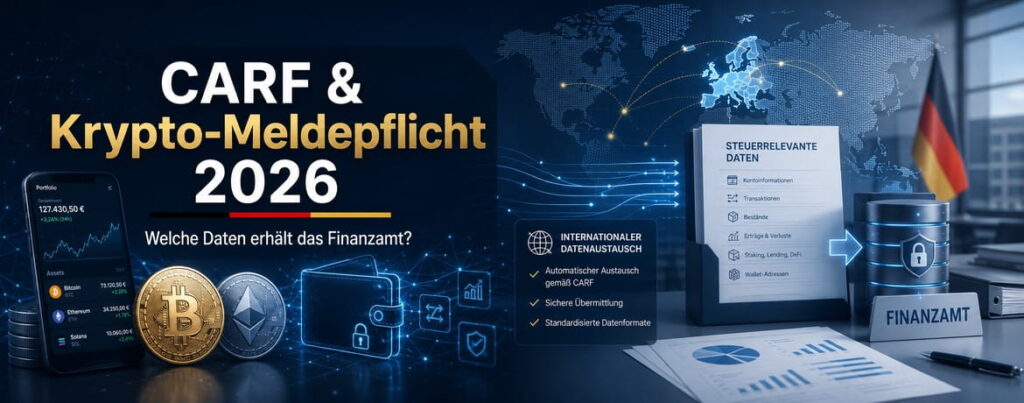
CARF and crypto reporting requirements in 2026 – current status: What information will the tax authorities receive, and what should taxpayers do?