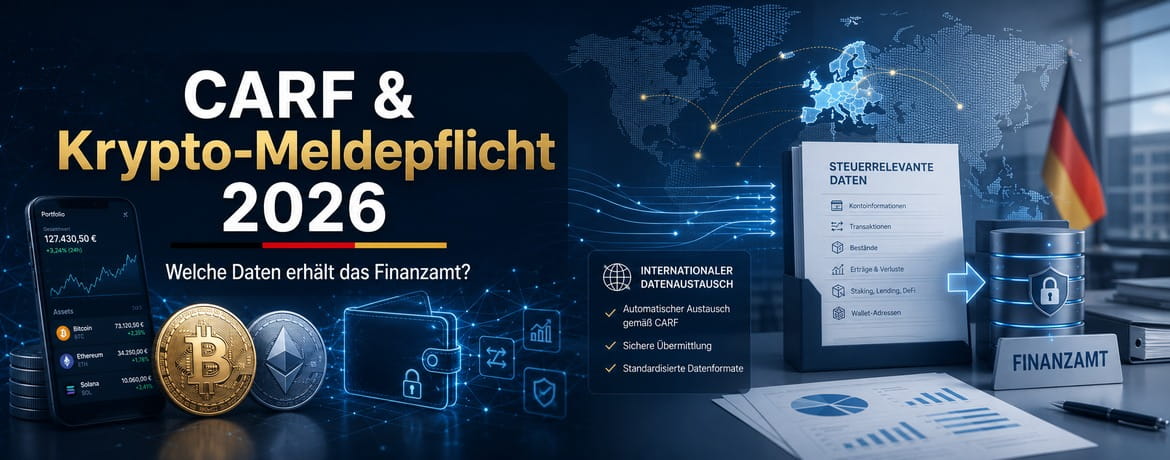
Crypto exchanges and other crypto service providers subject to reporting obligations must report extensive information about their customers and transactions to the tax authorities. The Crypto-Asset Reporting Framework – CARF for short – establishes the international framework for exchanging this information between tax authorities.
For German crypto investors, this means that transactions carried out on foreign crypto exchanges may also be automatically reported to the German tax authorities in future.
The following questions are particularly common:
- What should you do if you have not declared crypto gains from previous years?
- What crypto information will be reported to the tax authorities?
- Will wallet addresses also be reported?
- Which crypto exchanges are subject to the reporting requirements?
- Which countries participate in the exchange of information under CARF?
- From when will the tax authorities receive this information?
CARF explained: What is the Crypto-Asset Reporting Framework?
The Crypto-Asset Reporting Framework (CARF) is an international reporting standard for crypto-assets developed by the OECD.
CARF requires certain crypto service providers to:
- identify their customers for tax purposes
- determine their customers’ tax residence
- record certain crypto-asset transactions
- report this information to the relevant tax authority
The tax authorities then generally exchange this information with the country in which the user is tax resident.
As a result, a German investor may in future also appear in the records of the German tax authorities, even if their crypto transactions were carried out through a foreign exchange or platform.
Germany signed the Multilateral Competent Authority Agreement (MCAA) for CARF on 26 November 2024. The agreement itself had already been developed by the competent authorities on 8 June 2023.
What is the current status of the CARF legislative process in Germany?
Updated on 12 October 2026
On 8 October 2026, the German Bundestag passed the bill approving the multilateral CARF agreement. The Finance Committee had approved the bill on 7 October.
The legislation concerns Germany’s domestic approval of the international agreement and is intended to provide the legal basis for exchanging tax-relevant crypto-asset information with participating non-EU countries. The Bundestag’s approval must be distinguished from the legislation entering into force and the actual start of the exchange of information.
It is important to distinguish between:
- the obligation of crypto-asset service providers to collect and report information, and
- the subsequent international exchange of that information.
What is the difference between CARF and DAC8?
DAC8 is a European directive that expands the exchange of tax information within the European Union. It requires EU Member States to introduce reporting obligations for crypto-asset service providers.
CARF, by contrast, is the OECD’s international reporting standard. It is designed in particular to enable the exchange of information with countries and jurisdictions outside the European Union.
Germany has already introduced the corresponding domestic reporting obligations through the Crypto-Assets Tax Transparency Act (Kryptowerte-Steuertransparenz-Gesetz) of 22 December 2025. The CARF approval legislation passed by the Bundestag is intended to provide the additional legal basis for exchanging this information with participating countries and jurisdictions outside the European Union.
In simple terms:
- Crypto-Assets Tax Transparency Act (Kryptowerte-Steuertransparenz-Gesetz): domestic reporting and due diligence obligations in Germany
- DAC8: exchange of information within the European Union
- CARF: international exchange of information, particularly with countries and jurisdictions outside the European Union
From when will crypto-asset information be reported to the tax authorities?
The reporting and due diligence obligations under Germany’s Crypto-Assets Tax Transparency Act first apply to the 2026 calendar year. Reports must generally be submitted to the German Federal Central Tax Office by 31 July of the following year, meaning that reports for 2026 are due by 31 July 2027.
The first regular international exchange of this information is currently expected to take place in 2027. Numerous countries and jurisdictions have committed to implementing CARF in time for the exchange of information to begin by 2027.
This does not, however, mean that earlier tax years are of no relevance to the tax authorities.
If the information reported for 2026 indicates that accounts, wallets or trading activities have existed for a longer period, the tax authorities may also review earlier tax years and request further information.
What information must crypto exchanges report to the tax authorities?
Crypto-asset service providers do not report only account balances or portfolio values. They must also report personal identification details together with information on certain crypto-asset transactions.
Personal information about the crypto user
The following information may be reported for individual taxpayers in particular:
- first and last name
- residential address
- country or countries of tax residence
- tax identification number (TIN)
- date of birth
- place of birth, where applicable
- other information required for unique identification
For companies and other legal entities, additional information about the beneficial owners may also be required.
This is intended to prevent crypto-asset transactions from escaping tax attribution through the use of companies or other intermediary legal entities.
Transaction information reported by crypto exchanges
The reportable transactions may include in particular:
- purchases of crypto-assets using euros or other fiat currencies
- sales of crypto-assets for fiat currencies
- exchanges between different crypto-assets
- transfers to other exchanges or wallets
- transfers to self-hosted wallets
- the number or quantity of tokens transferred
- the total value of purchases and sales
- gross proceeds from disposals
- acquisition costs, where applicable
- the number of individual transactions
For example, exchanging Bitcoin for Ether or one token for a stablecoin may be treated economically as a disposal of the crypto-asset given up and an acquisition of the crypto-asset received.
For reporting purposes, the amounts are generally valued in a fiat currency. The information is usually reported on an annual basis and aggregated by the respective type of crypto-asset.
Are staking, lending and airdrops also reported?
Transactions relating to the following may also be reportable:
- staking
- lending
- airdrops
- crypto loans
- DeFi applications
- other reward or compensation models
may also be identifiable in the reported data.
Whether and in what form a particular transaction is reported depends on how the relevant crypto-asset service provider is involved in the transaction and how the transaction is classified under the CARF rules.
The reporting itself does not determine the German tax treatment. The tax treatment must still be assessed in accordance with German tax law.
For example, staking rewards, lending income, airdrops and token swaps may each be subject to different tax treatment, even though they may initially appear in the platform data simply as incoming or outgoing transactions.
Are wallet addresses reported to the tax authorities?
Not every individual wallet address is automatically included as standard information in the annual CARF report.
CARF does, however, provide that transfers to so-called unhosted or self-hosted wallets may be reported separately. In particular, the number of units transferred and the total value of those transfers may be included in the report.
This enables the tax authorities to identify when crypto-assets have been transferred from an exchange to an external wallet.
The specific public wallet address is not necessarily included in every regular annual report under the OECD framework. However, it may:
- be known to the crypto-asset service provider
- be stored in the provider’s internal transaction records
- be disclosed in response to a specific information request from the tax authorities
Transferring crypto-assets to a hardware wallet or another self-hosted wallet does not make the transaction invisible for tax purposes.
Can the tax authorities identify transfers between your own wallets?
A transfer between two of your own wallets does not, in itself, generally constitute a disposal for tax purposes.
From a crypto exchange’s records, it may initially only be apparent that crypto-assets have been transferred from the platform to an external wallet address. Whether the destination wallet also belongs to the investor cannot necessarily be determined from that information alone.
For crypto investors, it is therefore becoming increasingly important to maintain clear records demonstrating ownership of their wallets and documenting transfers between their own wallets.
If this documentation is missing, there is a risk that:
- transfers between your own wallets cannot be clearly identified
- acquisition costs can no longer be reliably traced
- deposits and withdrawals cannot be matched correctly
- apparent discrepancies arise between the platform reports and the tax return
Which crypto-assets are covered by CARF?
The definition of reportable crypto-assets is broad.
This may include, in particular:
- Bitcoin
- Ether
- altcoins
- stablecoins
- certain utility tokens and investment tokens
- tokenised assets
- certain non-fungible tokens (NFTs)
- crypto-assets that can be used for payment or investment purposes
Not every NFT or digital asset automatically falls within the scope of CARF. One of the key factors is whether the asset can be used for payment or investment purposes.
Central bank digital currencies (CBDCs) and certain e-money products are generally not covered by CARF. Instead, they are intended to fall within the scope of the expanded Common Reporting Standard (CRS) rules.
Which crypto-asset service providers are required to report information?
The reporting requirements do not apply only to traditional crypto exchanges.
The reporting requirements may apply in particular to:
- centralised crypto exchanges
- crypto brokers
- providers that exchange crypto-assets on behalf of customers
- certain wallet providers
- operators of crypto trading platforms
- other service providers that carry out reportable crypto-asset transactions for or on behalf of customers
What matters is not the name or label of the business, but the activities it actually performs.
Decentralised or internationally operating business models may also fall within the scope of the reporting requirements where a legal entity or an individual acts as a reportable crypto-asset service provider.
Which countries participate in the CARF exchange of information?
Many countries and jurisdictions have committed to implementing CARF or have already signed the Multilateral Competent Authority Agreement (MCAA).
This includes, among others:
- Germany
- most EU Member States
- the United Kingdom
- Switzerland
- Liechtenstein
- Norway
- Iceland
- Canada
- Japan
- South Korea
- Singapore
- Brazil
- Chile
- Costa Rica
- Colombia
- South Africa
- the United Arab Emirates
- New Zealand
- the Cayman Islands
- Jersey
- Guernsey
- the Isle of Man
- Gibraltar
However, a political commitment or signature alone does not automatically result in an effective exchange of information between two countries.
An effective exchange relationship generally requires that:
- both countries have implemented CARF in their domestic law
- the required declarations and notifications have been submitted
- both countries have activated the relevant exchange relationship
The list of countries with which Germany exchanges crypto-asset information may therefore change over time.
Does every foreign crypto exchange automatically report information to Germany?
No. A foreign crypto exchange does not automatically report information to Germany simply because German customers use the platform.
Whether information is reported depends in particular on the following factors:
- the country in which the provider is subject to reporting obligations
- whether that country has implemented CARF or comparable rules
- whether an effective exchange relationship exists with Germany
- whether the user has been identified as tax resident in Germany
Providers operating within the European Union may also be subject to reporting obligations under DAC8.
Even if a country does not yet participate in the automatic exchange of information under CARF, the German tax authorities may still be able to obtain information through other international administrative assistance mechanisms or individual requests for information.
Does the tax office automatically calculate your crypto gains based on CARF data?
No. The reported amounts do not automatically correspond to the taxable crypto gains under German tax law.
CARF primarily provides the tax authorities with verification and transaction data. This may include, for example, gross disposal proceeds, transaction volumes, deposits and withdrawals.
To calculate the taxable gain, the following factors must also be taken into account:
- individual acquisition costs
- acquisition dates
- disposal dates
- holding periods
- transaction fees
- transfers between your own wallets
- lost or worthless tokens
- the relevant category of income
- whether the activities constitute private asset management or a commercial business
A reported transaction volume of, for example, one million euros does not therefore mean that a taxable gain of one million euros has been realised.
However, the tax authorities may compare the reported information with the tax return and request additional documentation if discrepancies are identified.
What discrepancies may be identified by the tax authorities?
The automatic exchange of information may, in particular, reveal indications of the following:
- undeclared crypto disposals
- undeclared crypto-to-crypto exchanges
- undisclosed foreign crypto exchanges
- unreported staking or lending income
- transfers to previously undocumented wallets
- discrepancies between tax reports and exchange data
- high transaction volumes despite no corresponding information in the tax return
- inconsistent information regarding tax residency
- incomplete reporting of trading activities from previous years
Such discrepancies may lead to requests for information, enquiries by the tax authorities, tax audits or, in some cases, criminal tax investigations.
Can CARF also affect previous tax years?
The regular CARF reporting requirements are generally intended to cover only the designated reporting periods.
Nevertheless, the reported information may give the tax authorities reason to examine earlier tax years as well.
For example, the following may prompt further review:
- long-standing user accounts
- substantial opening balances
- historical deposits
- transfers from previously unknown wallets
- missing acquisition cost records
These may indicate that tax-relevant transactions already took place in earlier tax years.
The tax authorities may then request additional documentation or review tax returns from earlier years.
What should crypto investors review now?
Crypto investors should not wait until they receive a letter from the tax authorities before organising their records.
In particular, the following should be reviewed:
- Have all crypto exchanges, brokers and wallets been fully accounted for?
- Are complete transaction histories available?
- Have closed or inactive exchange accounts been taken into account?
- Are transfers between your own wallets clearly identified?
- Can the acquisition costs of all disposed crypto-assets be substantiated?
- Have staking, lending, mining, airdrops and DeFi transactions been included?
- Do the opening and closing balances reconcile?
- Have all foreign crypto exchanges been taken into account?
- Does the crypto tax software output match the original transaction data?
- Have all tax-relevant years been reported correctly?
Crypto tax software can assist with preparing your records. However, its results are only as reliable as the imported data and the underlying tax treatment applied.
What should you do if crypto gains have not been declared for tax purposes?
Anyone who discovers that previous tax returns were incorrect or incomplete should not simply report individual gains without first obtaining a proper review of their overall tax position.
The first step is to determine whether:
- there is an obligation to correct the tax return under Section 153 of the German Fiscal Code (Abgabenordnung – AO), or
- a voluntary disclosure under Section 371 AO may be required because of potential intentional tax evasion.
To be effective, a voluntary disclosure must, in particular, be complete. As a general rule, it must cover all non-time-barred tax offences relating to the relevant type of tax.
A disclosure limited to individual exchanges, wallets or tax years may therefore be insufficient.
In addition, the exemption from criminal liability may no longer be available if a statutory exclusion has already taken effect. This may be the case, for example, where certain tax audit measures have begun, criminal tax proceedings have been formally initiated, or the tax offence has already been discovered.
Should you wait until CARF reporting begins before correcting your tax position?
No. If you discover errors in your tax affairs, you should not wait until the tax authorities receive the CARF data before taking action.
The sooner the matter is reviewed in full, the better the following can be addressed:
- obtain missing transaction records
- reconcile wallets and exchange accounts
- determine taxable gains
- assess whether there is an obligation to correct previous tax returns or make a voluntary disclosure
- reduce potential criminal tax risks
Once a formal request for information has been received or tax or criminal tax proceedings have been initiated, the available legal options may become more limited.
How should crypto records be documented for the tax authorities?
A robust set of records should, where possible, include:
- complete transaction records from all crypto exchanges
- all wallet addresses and, where applicable, documentation showing wallet ownership
- deposit and withdrawal records
- evidence of transfers between your own wallets
- acquisition and disposal dates
- historical valuations and valuation methods
- transaction fees
- staking and lending statements
- airdrop and mining records
- tax reports together with the underlying calculation methodology
Providing only a summary tax report may be insufficient if the underlying transactions cannot be traced and verified.
Crypto investors should be aware of this: CARF significantly increases transparency in relation to crypto-assets.
CARF does not introduce new tax rules for Bitcoin or other crypto-assets. The applicable tax treatment continues to be determined under German tax law.
The main change is the increasing availability of standardised reporting data.
Crypto exchanges and other crypto-asset service providers are required to collect information about users and their transactions. This information is then intended to be exchanged internationally between tax authorities. As a result, foreign exchange accounts and transfers to external wallets may also become visible to the German tax authorities.
As a result, crypto investors face an increased risk that undeclared or incompletely declared tax matters may be identified by the German tax authorities.
Anyone who identifies uncertainties in previous tax returns should have their records reviewed thoroughly and at an early stage.
ACCONSIS supports you with crypto tax matters, tax corrections and voluntary disclosures
ACCONSIS advises private investors, business owners and crypto investors on the tax review and assessment of their crypto transactions.
Our advisory services include, in particular:
- reviewing the completeness of exchange and wallet records
- reconciling different crypto tax reports
- assessing the tax treatment of trading, staking, lending, mining, DeFi and NFTs
- reviewing transfers between your own wallets
- calculating taxable crypto gains
- correcting incomplete tax returns
- preparing and submitting voluntary disclosures to seek exemption from criminal liability
- assisting with requests for information from the tax authorities
- representing clients during tax audits and criminal tax proceedings
Have you omitted crypto transactions from previous tax returns, or are you concerned that they may not have been reported in full? If so, you should have your tax position reviewed before the German tax authorities take action following a report under CARF or a formal request for information.
Media coverage
Börse-Online: Im Interview mit Dr. Arendt – über Kryptowährungen, Wein und Zockerei (PDF-Datei)
Börse-Online: “Bitcoin, Ethereum & Co: So kassieren Sie Ihre Gewinne steuerfrei”, 07/2024
Börse-Online, Kryptogewinne in der Steuer angeben?, 02.04.2024
Börse-Online, Schmelzender Gewinn – Kryptoanlagen, Ausgabe 31/2023, Aug. 23 (€)
Börse-Online, Kryptogewinne: Fiskus macht Jagd auf Steuerhinterzieher, 02.06.2023
Börse-Online, Kryptogewinne immer steuerfrei? So hat der Bundesfinanzhof entschieden, 28.02.2023
Your ACCONSIS contact

Dr. Christopher Arendt
Lawyer, specialised lawyer for tax law
Managing Director of ACCONSIS
Service phone
+49 89 547143
or via email
c.arendt@acconsis.de
Image source:
KI with DALL-E